
Atelier Update on 13 Sep 2025
Summer activity on: Culture upstream of politics; Using futures for decision-making; and, For-impact (mostly also for-profit) start-up ecosystem.

How are you doing? Been a while! Have you been up to anything over...the entire summer? Probably quite a lot. Too much to go into detail. I know what you mean…
Apologies, everyone. As predicted, my 3 days a week with Absurd Intelligence have knocked my ability to do weekly reflections on this SubStack. For one thing, I am a lot fuller, with more time filled with inflexible meetings, deadlines or tasks. For another, a lot of the work in Absurd Intelligence is confidential, and can't be shared (at least, not as it happens).
Then I convinced myself that the next WeekNote would need to be a catch up on all the stuff that I could have written about. Which made producing the next WeekNote a huge task. Which meant it got delayed. And I once again 'learnt' (that is to say, I experienced, and now have the chance to learn that) the perfect is the enemy of the good.
So, today I'm going to update according to the three emerging clusters I described at the end of June.
A quick 'work-in-progress' description of Absurd Intelligence.
The Fate of Britain Convention.
Narrative Power Session.
Using futures for decision-making.
The Fizz, with Andrew Curry and Chatham House
Also, I have some half-ideas about how to return to a weekly publications, which I will share next week.
How can the Atelier of What's Next be of service to you, and your purposes? We'd love to hear from you. Perhaps you have a challenge or idea to put in the studio. Maybe one of our existing topics appeals to you. What if you love to make new things happen by being part of the studio? Or if you have feedback or comments that would improve this deck. Either click the button below or email davidbent@atelierwhatsnext.org.

INITIATIVE CLUSTERS
Culture upstream of politics
Basically, this is the work with Absurd Intelligence and its extended universe of projects and alliances.
A quick 'work-in-progress' description of Absurd Intelligence
Absurd Intelligence (AI), was formed by the creative and media teams from Extinction Rebellion, including co-founder Clare Farrell. A summary of its absurd and audacious efforts:
The core thesis is that the world is sleepwalking into a perfect storm of climate, economic and democratic turmoil. We urgently need to defibrillate the collective imagination.
AI's contribution is to generate a mass movement in arts and culture, with the intention of driving an emotionally-mature public discourse, leading to the creation of a new democratic reality.
All AI's efforts are based around establishing two narrative truths: (1) on agency: “We can – and will – collectively make a better way to live”; and, (2) about the core of society: replace the old story of that 'consumption will make you happy' with a new story of care and freedom.
The aim: creating a positive, citizen-led transformation of how we live in the face of climate breakdown.
There are several strands, including:
The Fete of Britain has a long-term purpose changing the culture of UK so we have a politics which is fit for climate change (happy co-benefit, push back on hard right.) Our 2029 ambitions: at least 50% of UK population have heard of the Fete of Britain, and have a positive sentiment; and there has been a Fete of Britain in every neighbourhood of the UK. (That's roughly 8,000, if we use wards as a proxy.)
Speak Up is a purpose-driven speaker agency setting the tone for a new conversation. Speak Up works with speakers to tell the stories missing from the mainstream news and culture.
Hard Art is a cultural collective standing in solidarity in the face of climate and democratic collapse. It helps artists work through how to bring these issues and narratives into their own work in their own way, and also be a reservoir for other threads to draw on.
The Fate of Britain convention is for the doers, the people who get work done, who want to connect across culture, democracy, grassroots organising, and especially inter-generationally and outside London. (For clarity, the Fate of Britain (with an A) aims at community organisers; the Fete of Britain with an E) at the general public.)
A sister organisation (also co-founded by Clare Farrell) is the Humanity Project, which exists to build something new: assembly culture.
So, a hugely ambitious and much-needed agenda! The absurd part of Absurd Intelligence is to 'be reasonable, and demand the impossible'. (Making the rational case for the incremental has had limited success in the world of sustainability.)
The Fate of Britain Convention
The Convention itself was Thu 11 Sep. Despite the tube strike, we had around 150 people from pretty much all corners of Britain.
Those people were, for the most part, grassroots organisers in their communities, the people who organise the food banks, the art cafes, the youth clubs, the performance spaces, the village halls, the mutual aid societies — the kind of deeply-rooted civil society activity which gives life belonging and meaning for many, many people. (There was also a smattering of connectors and national organisers.)
The purpose of the day was about giving these local organisers a sense of their own agency and power, that, together, they are already forming glimpses of a better Britian. Together, we can do more than that, and provide living examples that push back on our failing politics.
The flow we had planned was:
Welcome: people felt greeted and that they were arriving somewhere where they could relax.
Connect: get to know other people, and see the range of work that is going on.
Empower: learn something from their peers that they could apply where they are.
Transcend: go beyond an ordinary event (enjoy and then forget) into a memorable experience and a desire to join in going forward.
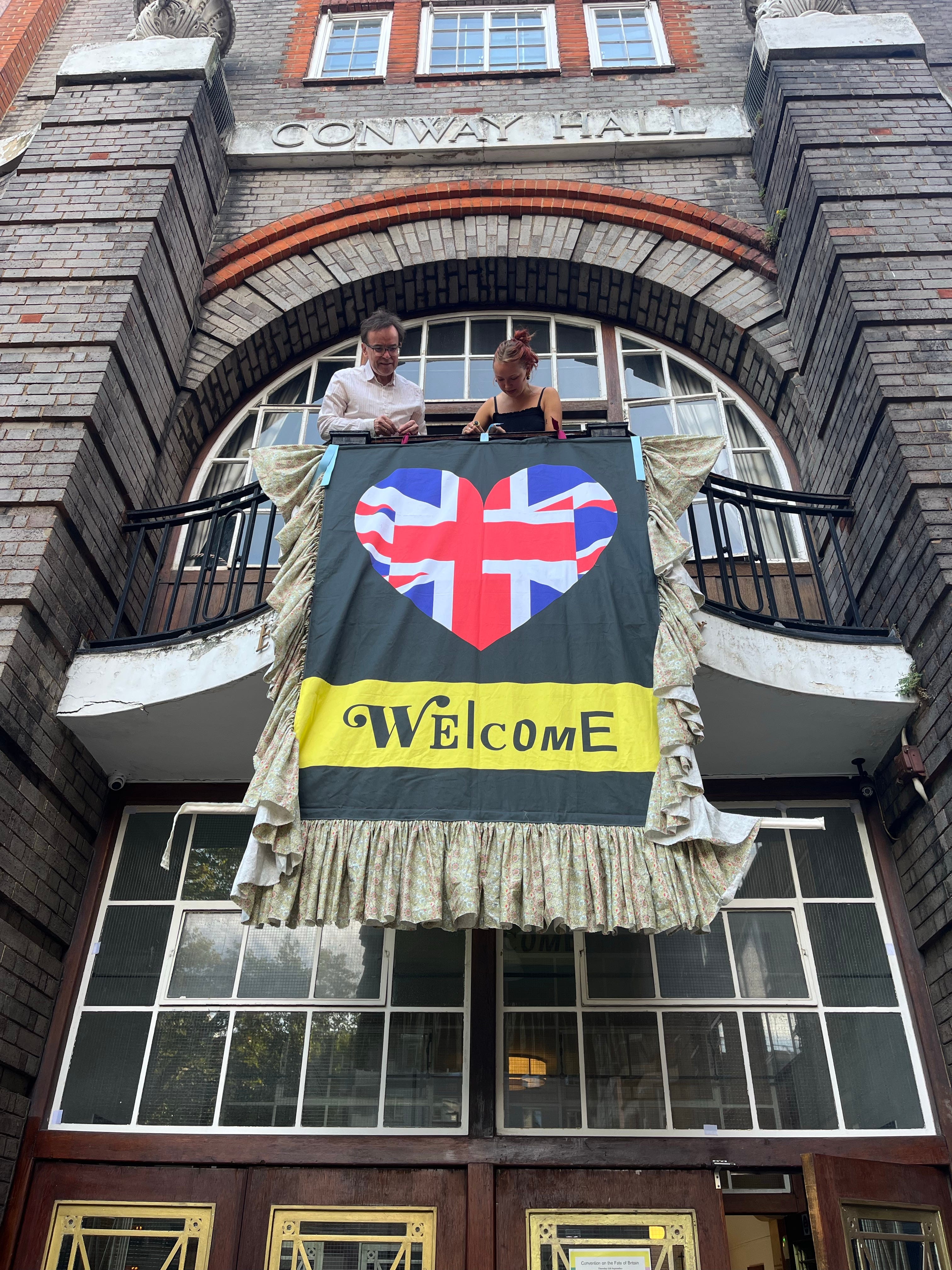
I won't go through all of the ways we designed the event to give people those feelings. But a key one was visual design. So, there was a literal welcome sign on the building, using the fragmented Union Jack as a statement of connection to the nation but also a desire to improve it.
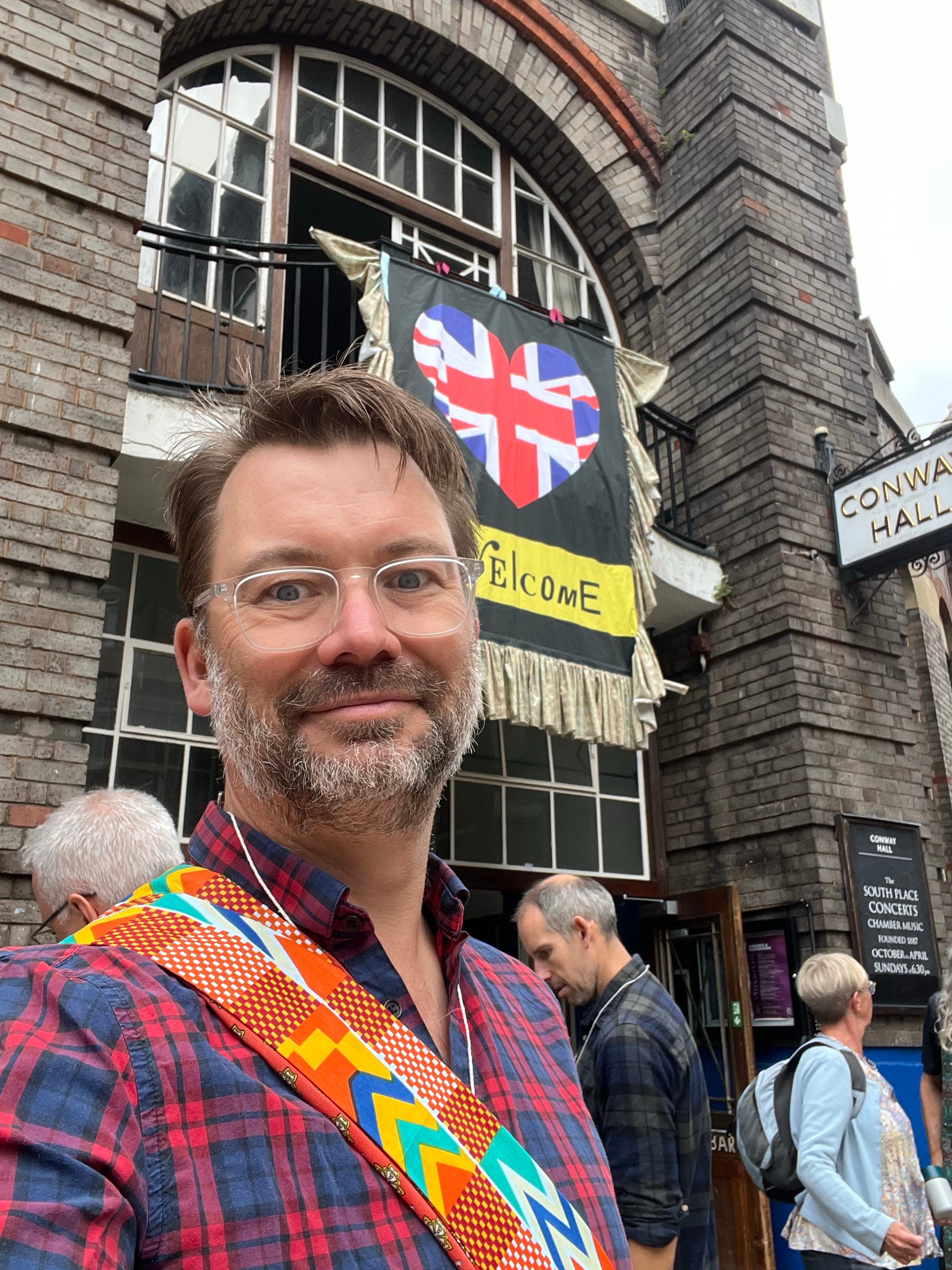
I myself was one of the greeters on the front door, smiling and saying hello to people and then directing them to the registry. All the crew working on the event had sashes (you can see the top of mine). These were designed to evoke the sashes used by Suffragettes, and were made from a William Morris pattern one side, and an African fabric on the other. So, successful protest, an English political radical, and acknowledging the legacies of empire, all in one package.
The dressing inside Conway Hall also played with national iconography, with the fragmented Union Jacks on boxes, plus you can just see on the lip of the stage a Union Jill (an alternative culture version of the Union Jack). The rest of the buildings had posters with some of our key phrases, for instance:
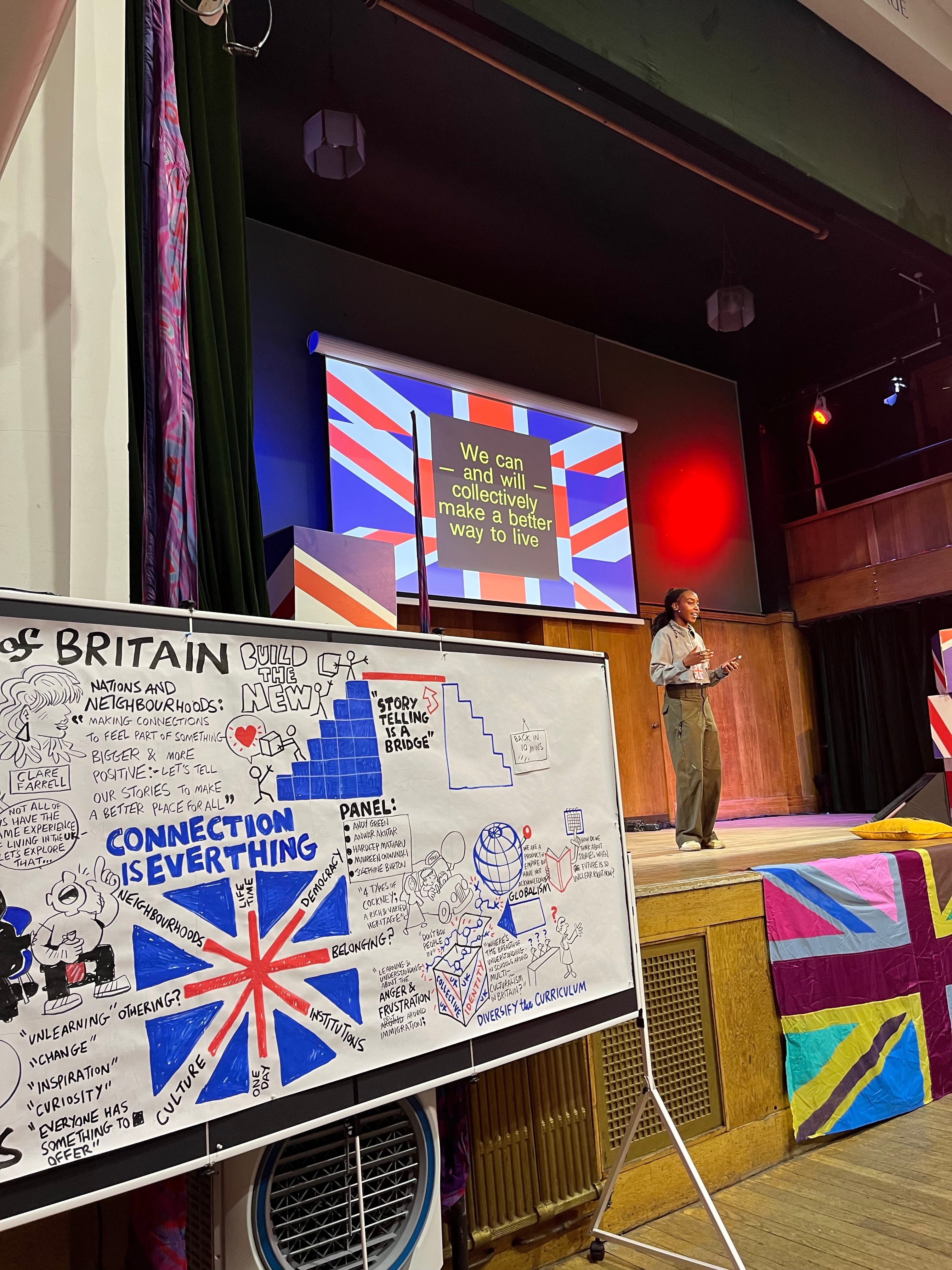
"We can — and we will — collectively make a better way to live."
"A nation that plays together stays together."
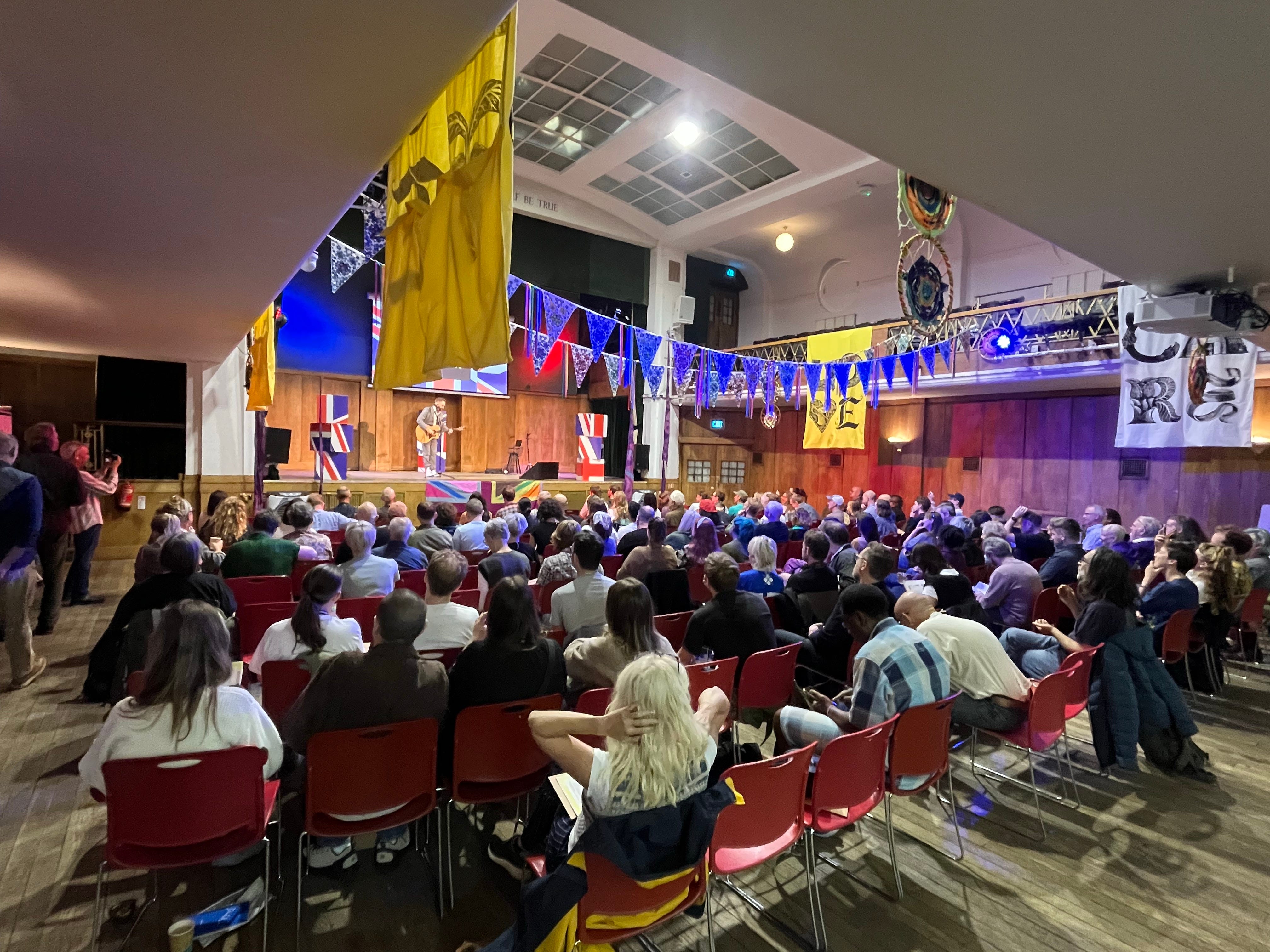
The experiences through the day went from stand up comedy, through a small number of speeches, three-way dialogues on life stories, a panel on identity, content sessions, and, to end, a poem from our poet-in-residence (pictured below), and a Lancastrian folk song from the 1870s to close.
Based on what people told us afterwards in the pub, and via electronic channels, people did feel connected, inspired, that they had more poiwer and they wanted to join in.
There will be more reflections, and more to say in general, on AI's work. For now the Convention was a success, and is also validates a number of our working hypotheses, on movement building for grassroots organisers and what AI's unique position in the ecosystem of change efforts can be.
WHAT NEXT
Lots planned, including a regular (monthly?) online session for grassroots organisers that is somewhere between a Zoom call and Eurotrash (Channel 4's hit late night show of the 1990s, if you don't know about it, ask your parents).
Watch this space.
Narrative Power session
My particular contribution to the day was one of the four parallels hour-long sessions, in my case on narrative power. To my surprise, some 60 or so people wanted to join (a sign of how important narrative and power are in the current discourse). We only had space for 30.
The purpose of the session was:
Explore how we believe that ‘narrative’ and ‘power’ relate to each other.
Start to map how our national narratives are produced and how they change over time.
Identify implications for participant’s organisations.
On how narrative and power relate to each other, I used Steven Lukes notion of the Three Faces of Power (from his book, Power: A radical view). For Lukes, the three faces are
Power to make decisions. The most obvious one. For instance, I made the decision that the first 30 people in the room could stay in the session, every one else had to go somewhere else.
Power to decide what gets decided (aka non-decision-making power). The power that groups and individuals have to control the agenda in debates and make certain issues unacceptable for discussion in moderate public forums. For instance, those of us who designed the event determined what the 4 parallel sessions would be. People who wanted to engage with other topics didn't have a chance, within that part of the day.
Power to frame thoughts and desires (the power to decide what gets decided of what gets decided). The hardest to grasp, and Lukes' main contribution. He called this the power to influence individuals so that they will want things that they would otherwise oppose. Not the observable agendas set or decisions made, but the often-hidden process that crafts cultural preferences and available thoughts. Influence here is as much through form, reach and channel as it is through content.
For example, we've lived in neoliberalism for so long, that all the habits of thought of technocrats and public debate are in terms of Cost Benefit Analysis, and market value. It is hard to say things have intrinsic worth, and arguments for this go against the grain of the orthodoxy in quite painful ways. The Thatcherite slogan of There Is No Alternative has become true, not because there are no alternatives but because "it is easier to imagine an end to the world than an end to capitalism".
On how narrative and power relate, I asked people in small groups to talk on:
What’s your working theory of narrative power?
How would you rate the following in their importance in giving narratives power?
The content: emotionally compelling, can suspect disbelief.
The form: short oral myth, song, novel, film, poem, news coverage,...
The messager: trusted people and institutions.
The volume and reinforcement: how much of the available space the narrative takes up.
The peers: what people in my bubble keep repeating back to each other.
Something else.
A number of people said the most surprising insight was that narrative content is less important than the volume, reinforcement and degree to which everyone around you is reinforcing a particular narrative.
Then, for the mapping I asked small groups to consider individual questions from this list:
Mainstream
How are the current mainstream narratives re-produced?
How is small ‘c’ culture reproduced and reaffirmed in the UK?
Who are the institutions or players most important in maintaining them? As well as media, consider other institutions which people interact with in their daily lives.
How do people at different lifestages get ‘narratived’? (Childhood (e.g. schools); Young adulthood; Middle age; Old age.)
Emerging
What was the last narrative to enter the mainstream?
Where did it come from?
What needed to be true for this narrative to join with, and shift, the status quo?
Where are the niches and sources for new narratives, which may enter the mainstream at some point?
People found that there were many ways the mainstream narrative was reinforced that had little to do with the media, for instance:
The way in which land owners demand rent forces all land-users (which is to say, everyone) to join in with market economics, and market power.
For children, the toys they play with and the social 'indoctrination' of schooling.
For young adults, the lack of 'third space' narrows where narratives can be experienced.
WHAT NEXT
Nothing specific for this set of questions.
But does reinforce to me that the social processes that reinforce narratives (and occasionally nurture the emergence of new ones) is under-considered in the sustainability world, compared to the narrative content.
Using futures for decision-making
The Fizz, with Andrew Curry and Chatham House
Previously I have written about exploring the next version of horizon-scanning that was the CUSP Bulletin, in collaboration with noted futurist Andrew Curry (subscribe to Just Two Things here) and Chatham House's Sustainability Accelerator. Over the summer, a lot as happened, including getting the working title of The Fizz.
Where we have got to (and this is a partial summary):
Our purpose: provide provocations and a chance to play for those who are curious about the dramatic changes the world is experiencing. (The Fizz sits within the Sustainability Accelerator's two year research programme called The Rift, so our short-hand for these people is 'Rift-curious'.)
Our aim: the provocations and playing allows the Rift-curious to find similar others and to act where they are, so our mainstream institutions adapt to the drastic changes (and also new institutions emerge too), a part of the wider activities in The Rift.
Focus: issues which are early and still emerging, for instance hard to categorise. We believe that the more mature issues with a shorter-term effect are well catered for by trends and other existing futures outputs.
Using Artificial Intelligence: We are seeing two 'modules':
Scanning. Taking a stream of feeds and pulling out the 'seeds' which are of interest to Rift content (collapse and renewal), are 'young' and then tagging them in various ways, before putting them in a seeds data base.
Provocation creation. Generate kernels of future worlds that are enticingly incomplete, and so people cognitively get involved with developing them. In our method, we are inspired by Seeds of a Good Anthropocene and the Manoa Method.
There's huge potential here, making it easy to give people credible-enough scenarios which stretch them, and help them think differently together about today. Also, the databank of seeds is potentially useful and valuable.
WHAT NEXT
Creating the prompts that perform the two modules, to a Minimal Viable Product (MVP) level.
Testing that MVP, and seeing if there is enough potential for the next round of funding.
For-impact (mostly also for-profit) start-up ecosystem
A quieter time over the summer. Just one contribution as a Conduit Connect Venture Partner.
WHAT NEXT
Will ramp up in the coming months.