
Atelier Update: Feb 2026
0/DETECTING. A high watermark of UK right populism? Corporate-enabled government surveillance. ATELIER MNGT. From ‘WeekNotes’ to ‘Updates’. INITIATIVES.Absurd Intelligence. The Fizz.

Welcome to the latest of my regular updates on the Atelier of What’s Next, a ‘studio for initiatives at the frontier of generating a better future’ (explained here).
It has been six weeks since my last update. It turns out acting as a COO of a narrative think-tank, starting a new futures company, doing the lectures of a Masters module and starting a doctorate is...time consuming in a fragmentary way. Apologies for the gap.
This week covers:
0/DETECTING.
A high watermark of UK right populism?
A personal experience of corporate-enabled government surveillance.
ATELIER MANAGEMENT.
From ‘WeekNotes’ to ‘Updates’
INITIATIVES.
Absurd Intelligence.
The Fizz
DOCTORATE.
ReadingNotes
Desperately seeking fixedness: Practitioners’ accounts of ‘becoming doctoral researchers’. (Hay & Samra-Fredericks, 2016).
Condescending ethics and action research: Extended review article. (Eikeland, 2006)
Autoethnography as an ethically contested terrain (Sparkes, 2024)
How can the Atelier of What’s Next be of service to you, and your purposes? We’d love to hear from you. Perhaps you have a challenge or idea to put in the studio. Maybe one of our existing topics appeals to you. What if you love to make new things happen by being part of the studio? Or if you have feedback or comments that would improve this deck. Either click the button below or email davidbent@atelierwhatsnext.org.

DETECTING
A high watermark of UK right populism?
I’m writing just after the Greens have had a historic win in the Gorton and Denton byelection. For the last few weeks I’ve been having a rare, rising optimism on the strength and durability of the Reform poll lead:
Campaigners and civil society are getting more active in responding, as know Labour aren’t going to lead and have had time to get our acts together (not just in Absurd Intelligence but elsewhere).
Now that McSweeney has moved on, Labour might stop shooting themselves in the foot. (Not going to rely on this.) Pissing off their progressive-values voters, and trying to reach socially conservative voters, by enacting policies that harm the country (we need immigrants) and help your political rivals (by validating Reform’s narrative) is one of the greatest unforced errors I’ve ever seen in British politics.
The negative consequences of Trump’s domestic policies, like ICE, will seep across.
More stories of what Reform propose and are doing. Reform will no longer be a blank slate for ‘anyone-but-the-failed-mainstream parties’. People will have experience of the councils where they are in power, and see Reform’s ICE-like proposals. Every time Farage brings in a Tory defector, he dilutes his own brand and associates Reform with the failed status quo, rather than being an insurgent outsider.
Tories might change leader to a more centre right, and give the Right block voters somewhere to go.
British people are basically decent and want fairness (without losing out themselves; loss aversion is real).
Reform poll numbers look soft. Half of Reform’s support is people who are convinced their identity is under threat from modern world and immigration. They are not going to move. But the second half is people feeling let down, left behind and left out. They are not actively for Reform policies (on immigration or anti-Net Zero). They are reachable by a centre right party that admits it made mistakes (so, if Cleverly becomes leader, and stops trying to out-Reform Farage).
Football World Cup will be a chance to see ourselves as a nation made of people from many heritages.
The economic news is getting a little better.
All of that is far from guaranteed. There are huge headwinds, especially:
The mainstream media being reflexively subservient to Reform’s narrative.
Lots of politicians and commentaries being Very Online, and getting their feel for UK from their distorted X feed.
So, there is lots to do. But lots that can make a difference.
You can see other thoughts on what to look for in the narrative development from my colleagues at Absurd Intelligence.
A personal experience of corporate-enabled government surveillance.
Last Easter, I tried to go on holiday to Spain. I hadn’t the small print: post-Brexit, you need 3 months left on your passport on the date you travel to Europe. My family and I had...2 months and 4 weeks. But it wasn’t enough. We never took the flight to Barcelona, stayed with friends in Malaga, visit Madrid or take the return flight from Cadiz.
In the middle of last year I got letters from HMRC saying that, because I had left the country with my children and there was no record of me returning, I was no longer eligible for Child Benefit. Like an idiot, I thought that too ridiculous for words (we never left! my youngest has been going to school! I filed my UK resident taxes!).
My attitude changed when I received a demand for repayment of the Child Benefit I had fraudulently claimed. I’ve asked for a mandatory reconsideration, and hope to win.
Clearly, I am an idiot for not responding to the seemingly-ridiculous first letters. My bad.
But it did get me thinking: how come they thought I had left the country? It couldn’t have been that part of the UK state which runs the border. We’d never left!
And, why did they think we hadn’t come back?
Then it clicked: I had a flight booked out to one place, but a return flight from a different city. Their ‘fraud alert’ algorithm had seen an out-flight only, but hadn’t matched to the return.
Which means that the information had come from one of the companies involved in me buying the ticket.
‘Surveillance capitalism’ is Shoshana Zuboff’s term for a political economy where companies collect user behaviour to predict and modify people’s actions for profit.
Given how much of our lives are online, Zuboff is particularly concerned with people’s online experiences — what they see, read, understand about their world — being shaped by companies for the companies’ own benefit.
Going beyond manufacturing consent, our digitally-infused world provides the opportunity to manufacture the content of people’s inner worlds, and inject that directly through their online experiences.
I had wondered if this experience was a form of ‘surveillance corporatism’, surveillance capitalism but in a corporatist political economy where governments and business interests reach an understanding on how to achieve their common interests. (Fascist corporatism is one way to understand Mussolini’s Italy, and the desires of the Trump-aligned BigTech bros.)
But the more likely thing is straight profit motive. Someone saw they could sell a database to a customer, it just so happens that customer is the state.
The government wants to cut benefit fraud, which is not an aim I disagree with. (Whisper it, but working in the local fraud department of the local Benefits Agency my summer job while at university, under the Major years. The stories I might tell.)
But the government lacks the ability to join up, and look at the border records, the passport records, or the school records. Or, maybe being able to join things up like that would be a worse situation.
I suspect my experience is more typical: one digital data point is treated as certainly true, and then there are many person-hours spent unwinding from the mistake.
ATELIER MANAGEMENT
From ‘WeekNotes’ to ‘Updates’
I’m very aware that I’m not keeping up the weekly cadence that was mostly true through 2023 and 2024. This reflects me getting busier in a more fragmented way, and that a higher proportion of my work is relational, rather than conceptual, which makes it harder to put in the public domain.
I had a look back at my original reasons for doing the regular updates:
The practice of writing regular notes and updates will require me to go through some kind of regular action learning cycle. (More on #weeknotes here.)
Doing that on Substack means I can test the functionality here, while being a little away from my own website and social media presence. I realise that traffic to both of those is small. I’m giving myself permissions to be rough around the edges.
The frequency matters less than being consistent. So, I’m going to move to monthly updates.
I’ve taken the opportunity to re-jig the format a little. I’m going to try out having some consistent sections:
ATELIER MANAGEMENT. My overall approach, strategy and practices (like writing the Update).
INITIATIVES. Stories, insights and reflections on the initiatives at the frontier of generating a better future.
DOCTORATE. My personal reflections on my doctorate, plus what I can safely share of that activity (for instance, capsule reviews of what I have been reading).
0/DETECTING. My sense-making of what is happening in the wider world, and in my direct context.
The order of these may vary, depending on what I suspect will help the reader get all the way through. (This is why 0/DETECTING is first this time.)
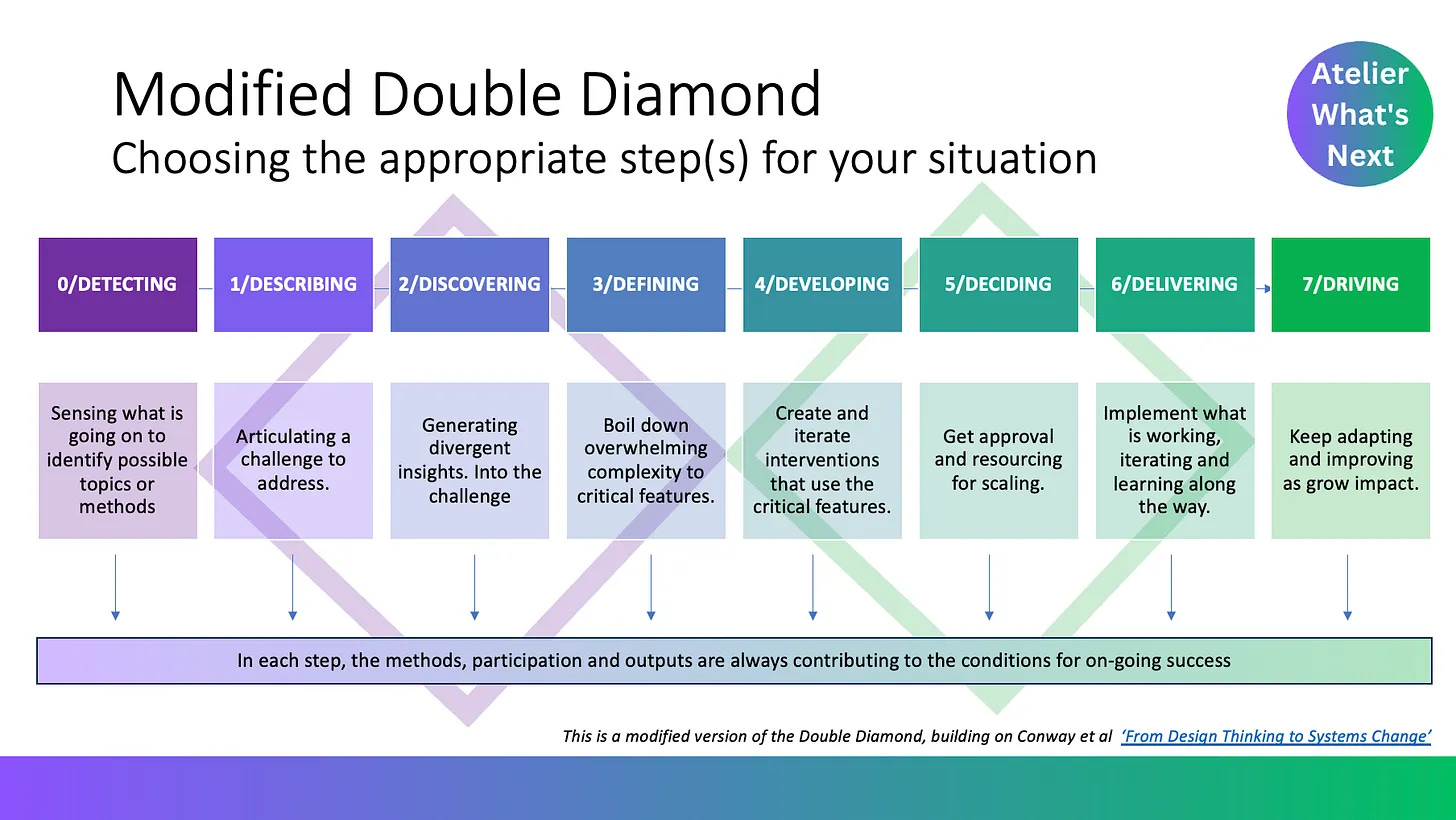
By the way, it is called “0/DETECTING” because it is the zeroth step in an attempted design process which draws on the Design Council’s Double Diamond via Rowan Conway. The “0” indicates it is the morass from which specifics emerge, in step 1/DESCRIBING:
WHAT NEXT
I’m going to play with this format for a while. But, it might make sense to separate out one or both of the Doctorate and the 0/DETECTING sections. We’ll see.
Signs of success:
Writing the updates regularly.
After writing them, having the feeling of landed something that was previously just floating about.
Increases in subscribers. (Though the number of subscribers is an ambiguous indicator.)
Any feedback from readers.
Speaking of which:
INITIATIVES
Absurd Intelligence
The first two months have flown by, with everyone else organising tonnes of campaigns, events and messaging — all to come out later in the year. Myself, I’ve been trying to create ‘just enough structure for abundance’ inside the organisation, from the cadence of meetings through the way we use our digital spaces, to the visual queues of the office space. Amongst other things. Still too senstive to write about explicitly, but hopefully I’ll get to that soon.
In the meantime, we now have a person working on the social channels of the Fete of Britain, a never-ending festival bringing us together to show that we can — and will — collectively make a better place to live. More here and here.


Good Neighbours show
The purpose: show civil society the great stuff that is already happening at the grassroots, as part of showing that we can, we will, we are making a better way to live.
Here’s the latest episode of Good Neighbours, filmed live from theGrabbing Hope event of the Humanity Project (’exists to build something new: assembly culture’) at Braziers Park, Wallingford, Oxford.
This month hosts Clare Farrell and Jessie-Lu Flynn get neighbourly with Haringey Community Food Network, Ridge Hill Together, Oswestry Climate Action Hub, as well as tuning into the Wallingford Community Jazz Festival, Britain’s Got Tarot, and more.
The Fizz
Positive developments, but still too confidential to share. Fingers crossed that will change for the next update.
DOCTORATE
#ReadingNotes Capsule Reviews
I am trying to write capsule reviews of my doctoral reading, as a way of summarising the content, and also my initial response to it, and how I might use it. Here are some first items.
Desperately seeking fixedness: Practitioners’ accounts of ‘becoming doctoral researchers’. (Hay & Samra-Fredericks, 2016)
Hay and Samra Fredericks used the journals of students and their own experience as teachers, to explore the experiences of practitioners enrolled on a UK Doctor of Business Administration (DBA) programme.
They start using the concept of liminality but their final conclusion is that this movement was never the classic sequence of separation, transition and incorporation. Probably because professionals who are researching never completely separate from previous ways of being since they moved back and forth between the unfamiliar classroom context and familiar workplace and home contexts over a prolonged period of time.
Key to students’ development were “threshold concepts”: places in the curriculum where students get stuck, but when grasped allow students to access new understandings.
Specifically, such concepts are deemed to encompass five characteristics: being troublesome (unsettling), integrative (raising new patterns and connections), bounded (establishing boundaries of knowledge areas), irreversible (unlikely to be unlearned) and transformative (shifting perception and action).
They had three findings:
Monsters of doubt are an integral and embodied aspect of threshold concepts.
Threshold concepts in this context is inherently linked to identity work.
The threshold concepts are negotiated in three taken-for-granted methods—scaffolding, putting the past to work and bracketing.
All three methods, worked to mitigate monsters of doubt by stabilising the self—a momentary fixing—in order to move forwards to become researchers.
Scaffolding, students seemingly steadied the “self” through fixing a sense of coherence across their relational networks.
Putting the past to work, they further fix the coherence of their identity across time.
Bracketing, they simultaneously suspended particular aspects of their past identities so that they could fix a workable—for present purposes—liminar identity.
My reflection would be that this requirement to have some stability (however created) in order for there to be change has echoes of liberal conservative Edmund Burke.
In terms of using these insights, first to be be aware that there are threshold concepts, places in the curriculum where students get stuck, but when grasped allow students to access new understandings.
Second, to use the three ways of providing enough fixed-ness for movement: scaffolding, putting the past to work, and bracketing.
Citation (APA7): Hay, A., & Samra-Fredericks, D. (2016). Desperately seeking fixedness: Practitioners’ accounts of ‘becoming doctoral researchers’. Management Learning, 47(4), 407–423. https://doi.org/10.1177/1350507616641599
Condescending ethics and action research: Extended review article. (Eikeland, 2006)
“Condescending ethics and action research” is an extended review article, where Olav Eikeland uses reviewing the book ‘Ethical issues in practitioner research’, edited by Zeni (2001), to say a little bit about philosophical ethics and action research.
His core argument is that action research breaks from the ‘othering’ which is fundamental in mainstream social research, because the people being studied are also included in the community of inquiry and interpretation. The radical step is from ‘we’ (researchers) studying ‘them’ (subjects) to an expanded ‘we’ studying ourselves.
Therefore, for Eikelund, the ethical question is transformed from ‘how should we relate to them?’ to ‘how should we relate to each other?’ — plus, decisively, ‘who are we?’.
Still, Eikelund believes it is not possible to eliminate ‘othering-effects’ completely, since we all are ‘others’ to each other. Instead, following Lee (2001), Eikeland proposes every action research effort needs to engage with the extent to which each person is practitioner and researcher and researched.
Also, we need to consider whether the research is interfering with the action, perhaps making ‘success’ (whatever that might mean to those involved) harder.
Eikelund also has a low-key warning for action researchers. Yes, they need to pay attention to the ethics entangled in seemingly small design choices (like who is to be involved) as these can lead to “spontaneous, habitual emergence of subtle power structures”. But also, action researchers cannot take for granted the larger aims of their research, even when for seemingly-obviously ethical goals like democracy, justice or emancipation.
I found myself in lots of agreement, and no real critiques. Eikelund has an analogy that mainstream research is a critic, in the audience, watching what is happening on stage. I wonder if that could be extended:
The action is the onstage performance.
Traditional social research is the critic watching the play (observer studying the observed).
Action research practice: the rehearsals, performance and then debrief, ready for the next performance, where the questions cover doing things better, doing better things and reimagining what we mean by ‘better’.
The application in my own work are on:
What are the ethics of my intentions, whether expressed in goals or method?
How to pay on-going attention to design choices, and downstream consequences, that allow “the spontaneous, habitual emergence of subtle power structures on a micro-level, not clearly visible in the beginning, but accumulating and ‘petrifying’ over time into larger unwanted patterns.”
Who and what to consider:
Future generations.
More-than-human world.
Could me doing a DOC get in the way of good work (existing or new)? in what ways? what to do about that: as prep, in the moment, and afterwards? eg a prompt q within a reflection stimulus?
Citation (APA7): Eikeland, O. (2006). Condescending ethics and action research: Extended review article. Action Research, 4(1), 37–47. https://doi.org/10.1177/1476750306060541
Autoethnography as an ethically contested terrain (Sparkes, 2024)
Sparkes argues that writing about oneself for research (’authoethnography’) faces similar ethical challenges as any other qualitative research approach. These need to be addressed in a principled and informed manner that necessarily rejects rigid assertions of ‘should do’ in favour of a more fluid notion of ‘it depends’ on time, context, culture and purpose.
He suggests six thinking points:
Whose story is it anyway? Our lives are entangled with others
The (im)possibility of anonymity and confidentiality. We should not make naive promises.
Informed consent. Can only be managed and negotiated throughout.
Member checking. Taking findings back to the participants to seek feedback on the researcher’s interpretations of their lives: fine, but careful on who can really know.
Do no harm to others. Yes to an ethic of care, but also a writer has now way to predict how their work will be received by others.
Do no harm to self. Writing might lead to getting stuck in a sticky web that acts agains ttheir own healing or interests.
My main reflection was that I will have to develop an ethics-in-practice for this research, with intention that an authentic and accurate description of that will not be rejected by a larger authority.
Citation: Sparkes, A. C. (2024). Autoethnography as an ethically contested terrain: Some thinking points for consideration. Qualitative Research in Psychology, 21(1), 107–139. https://doi.org/10.1080/14780887.2023.2293073